
It is a universal parenting dilemma: the weather outside is frightful, the screens have been on too long, and a chorus of “I’m bored” echoes through the hallway. As parents and caregivers, our immediate instinct is often to frantically search for ways to entertain our children. But what if we shifted our perspective? What if indoor downtime wasn’t just an obstacle to survive, but a golden opportunity to nurture critical physical and cognitive milestones?
Enter fine motor skills—the coordination of small muscles in movements involving the hands and fingers, interacting with the eyes. These skills are the invisible engines behind everyday triumphs like tying shoelaces, buttoning jackets, wielding a pencil with precision, and even typing on a keyboard. Far from being isolated hand exercises, fine motor mastery is tightly linked to neurological development and academic readiness. The best part? Children do not need tedious drills or expensive occupational therapy kits to build these pathways. They just need clever, engaging play.
Why Fine Motor Skills Matter More Than Ever
In our increasingly digital world, children are growing up swiping glass screens rather than manipulating physical objects. While digital literacy is vital, it cannot replace the complex tactile feedback loop between hand and brain. When a child molds clay, threads a bead, or pinches a clothespin, they are mapping out their brains in real time. Fine motor dexterity requires hand-eye coordination and proprioceptive feedback (awareness of body position in space).
Without sufficient practice, children may struggle with classroom tasks, leading to frustration and fatigue. Fortunately, childhood is hardwired for play. By turning skill-building into high-engagement indoor games, we can completely bypass the resistance to “learning” and dive straight into the fun.
7 Clever Indoor Games to Spark Joy and Build Skills
1. The Masking Tape Rescue Mission
- Skill Focus: Pincer grasp and spatial reasoning.
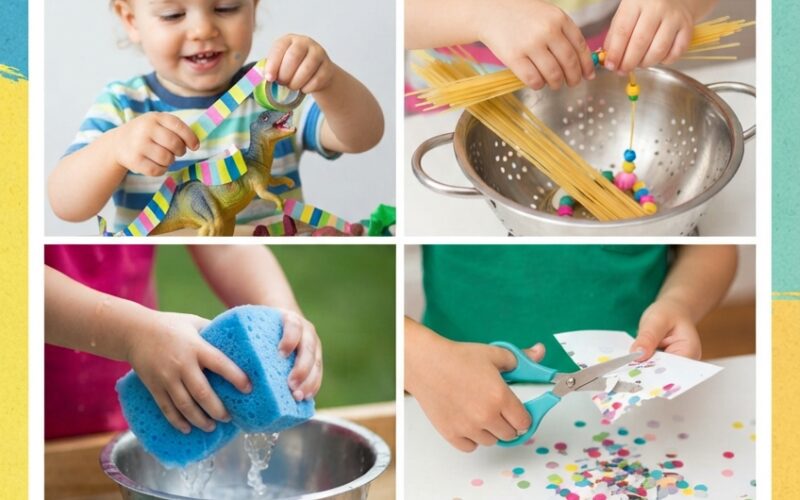
- How to Play: Children love a mission. Take brightly colored masking tape or painter’s tape and secure a handful of small plastic toys—dinosaurs, action figures, or counting bears—to a hard floor, tray, or table. Challenge your child to rescue the trapped toys using only their fingers to peel the tape up, strip by strip.
- Why It Works: Peeling tape requires immense patience and a refined pincer grasp (using the thumb and index finger). It forces children to stabilize the object with one hand while manipulating the adhesive with the other, fostering bilateral coordination.
2. Colander Spaghetti Rescue
- Skill Focus: Finger strength and dexterity.
- How to Play: Flip an ordinary kitchen colander upside down and grab a box of uncooked spaghetti noodles. Challenge your child to push the raw spaghetti strands through the small holes of the colander from one side to the other. For an added challenge, hand them colorful pony beads and have them thread the beads onto the upright noodles like little towers.
- Why It Works: Pushing rigid spaghetti into tight holes demands precise force modulation—too hard and the noodle snaps, too soft and it won’t go through. Threading beads onto the thin stalks refines visual-motor integration and finger agility.
3. Sponge Squeeze Water Transfer Relay
- Skill Focus: Hand dominance and bilateral coordination.
- How to Play: Set up two bowls on your kitchen floor or playroom rug: one filled with water and a few drops of food coloring, and an empty one placed a foot or two away. Give your child a clean kitchen sponge and task them with transferring all the water from the full bowl to the empty one by soaking it up and squeezing it out.
- Why It Works: The repetitive squeezing motion builds intrinsic hand muscles, forearms, and grip strength. It also teaches children cause and effect while keeping them happily occupied for surprisingly long stretches of time.
4. Rubber Band Geoboard Art
- Skill Focus: Finger isolation and grasping strength.
- How to Play: Take a small piece of wood or a thick corkboard, and hammer rows of nails halfway in (or use a ready-made plastic geoboard if you have one). Provide a collection of colorful rubber bands and challenge your child to stretch the bands across the pegs to create geometric shapes, animals, or abstract art.
- Why It Works: Stretching rubber bands requires a strong opposing force from the fingers and thumb. Manipulating small rubber bands isolates individual fingers, improving dexterity and spatial visualization simultaneously.
5. Q-Tip Toothpick Sculptures
- Skill Focus: Palmar arch support and control.
- How to Play: Combine a container of cotton swabs (Q-tips) or toothpicks with a tub of playdough, modeling clay, or even mini marshmallows. Instruct your child to act as an architect, building 3D towers, bridges, and geometric structures by linking the sticks together using the dough joints.
- Why It Works: Balancing and connecting objects requires precise wrist rotation and stability. Rolling dough balls to act as joints further stimulates palmar arches, which are essential for preventing hand fatigue during handwriting.
6. DIY Confetti Snipping Station
- Skill Focus: Wrist extension and scissor mechanics.
- How to Play: Set up a designated “snipping zone” with a pair of child-safe safety scissors and a collection of scrap paper, old junk mail, and colorful magazines. Challenge your child to snip the paper into tiny pieces to create their own homemade confetti.
- Why It Works: Scissor cutting is one of the most complex fine motor tasks, requiring independent hand movements, eye-hand coordination, and hand dominance. Snipping paper strips provides instant gratification while building essential pre-writing muscle memory.
7. The Secret Treasure Sorting Box
- Skill Focus: Tactile discrimination and fine manipulation.
- How to Play: Fill a shallow tray or shoebox with dried beans, rice, or pasta shells. Hide a dozen small beads, coins, or miniature toys deep within the mixture. Give your child a pair of kitchen tongs, large tweezers, or chopsticks, and ask them to fish out the hidden treasures.
- Why It Works: Tool use (tongs or tweezers) bridges the gap between hand and implement control. It refines grip pressure and demands intense concentration, turning a simple sensory bin into an elite fine motor workout.
Bringing It All Together
Indoor confinement does not have to spell disaster for parent sanity or child development. By transforming everyday household items—sponges, colanders, tape, and toothpicks—into clever play tools, you unlock hours of immersive entertainment while actively building the neural pathways your child needs for lifelong success. The next time boredom strikes, raid your junk drawer, set up a challenge, and watch your child build a brighter future, one small movement at a time.
